Interior Materials That Survive Chennai's Heat and Humidity
📅 March 2026 · ⏱️ 6 min read · ✍️ Budget Interiors Design Team
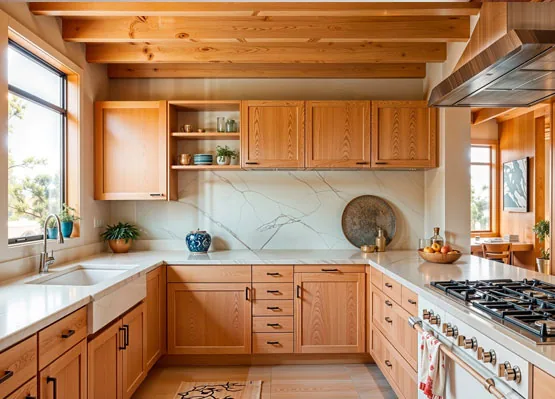
Interior Materials That Survive Chennai's Heat and Humidity
Chennai tests interior materials harder than almost any other Indian city. The combination of coastal humidity (averaging 75–85% through much of the year), intense heat (35–42°C in peak summer), salt-laden air in coastal neighbourhoods, and daily cooking steam in kitchens creates conditions that expose every material weakness within a few years. The interiors that look as good at year ten as year one aren't the most expensive — they're the ones built from materials selected specifically for this climate. Here's what survives and what doesn't.
Materials That Perform Well in Chennai
ISI-certified BWR/BWP plywood: The foundation of any lasting Chennai interior. Phenol-formaldehyde adhesive bond that doesn't delaminate in high humidity. This is the correct base material for all structural cabinet work — kitchen carcasses, wardrobes, TV units. No other wood-based panel material (particle board, commercial ply, standard MDF) performs comparably in Chennai's long-term humidity exposure.
Solid teak: Nature's own moisture-resistant wood. Teak's natural oils repel moisture and insects without chemical treatment. It has been used in South Indian coastal construction for centuries precisely because it survives the climate. For pooja units, headboards, feature elements, and any application where the natural material is part of the design — teak is the correct choice in Chennai.
Quartz countertops: Non-porous engineered stone. Doesn't absorb moisture, doesn't stain from turmeric or tamarind, doesn't require sealing. The material itself is inert to Chennai's humidity. Correct specification for kitchen countertops in the Chennai climate, particularly in coastal areas where granite's porosity creates maintenance issues.
High-quality laminates (Greenlam, Merino, Century): Properly applied to BWR plywood with factory-sealed ABS edge banding, quality laminates perform well in Chennai conditions. The weak point is always the edge — moisture enters through poorly sealed edges and damages the substrate beneath. Specify factory edge banding, not site-applied.
Vitrified ceramic tiles: The standard Chennai flooring material for good reason. Vitrified tile is non-porous, extremely hard, heat-resistant, and maintenance-free in Chennai conditions. Full-body vitrified tile (colour goes through the full thickness) is best for longevity — scratches don't show a different colour below the surface.
Aluminium and stainless steel hardware: For hinges, drawer channels, and cabinet pulls in coastal Chennai areas (within 5km of the sea), aluminium-body or stainless steel hardware is the correct specification. Zinc alloy (zamak) and chrome-plated steel hardware corrodes visibly within 2–4 years in salt-air environments. Branded hardware (Hettich, Häfele) uses corrosion-resistant coatings that perform better than unbranded alternatives.
Materials to Avoid in Chennai
Particle board (chipboard): The moisture-resistant versions are better than standard but still inferior to BWR plywood for sustained Chennai humidity. Standard particle board swells irreversibly when moisture enters at edges — and in a Chennai kitchen, moisture entry is a question of when, not if.
Standard MDF for structural applications: MDF absorbs moisture through cut edges and swells permanently. Fine for sealed shutter faces, decorative panels, and dry-interior applications. Never for carcass construction, shelf substrates, or anything with potential moisture exposure.
Regular painted or untreated mild steel: Rusts rapidly in Chennai's salt-humid air. For any metal element in a Chennai interior — cabinet frames, stair railings, door frames — powder-coated or epoxy-coated steel minimum, stainless steel for harsh environments.
Natural stone that requires regular sealing: Light-coloured granites in Chennai kitchens require diligent annual sealing to prevent staining from South Indian cooking ingredients. Without sealing, oil, turmeric, and tamarind absorb into the stone and create permanent discolouration. If you want natural stone without maintenance, choose quartz or a very dense dark granite.
Temperature, Humidity, and Salt Air: Chennai's Three-Front Challenge
Most interior material guidance in India is written for climates significantly more forgiving than Chennai's. Delhi's dry heat, Bengaluru's mild year-round weather, and even Mumbai's monsoon humidity — which is severe but seasonal — create different material demands from Chennai's combination of sustained heat (35–40°C for 8+ months), monsoon-season humidity that peaks at 90–95% RH, and for coastal areas (Adyar, Besant Nagar, Thiruvanmiyur, ECR, Neelankarai, Perungudi), significant salt-laden air that accelerates metal oxidation and affects certain coatings.
The interiors that fail prematurely in Chennai share a common characteristic: they were designed using materials and specifications developed for gentler climates and then applied unchanged in Chennai without adaptation. The inverses — the kitchens and wardrobes that function well 10–15 years after installation — typically involve four consistent elements: BWR or BWP certified plywood for all carcass work, appropriate surface finishes for the application zone, stainless steel or powder-coated aluminium for structural hardware exposed to moisture, and proper edge sealing and gap elimination to prevent moisture entry into panel cores.
Metals in Chennai Interiors: What Lasts and What Doesn't
Chrome-finished brass hardware — the most commonly specified handle and fitting material in Chennai's mid-market interior segment — oxidises in coastal Chennai conditions within 3–5 years, developing black patches and chalky white deposits that cannot be cleaned away without damaging the plating. In Thiruvanmiyur, Adyar, and Besant Nagar, this timeline compresses to 2–3 years due to direct salt air exposure. The alternatives that genuinely survive Chennai's coastal conditions: matte stainless steel (grade 304 SS, not just "stainless look" chrome), powder-coated aluminium, and PVD-plated brass (Physical Vapour Deposition — a significantly more durable plating process than standard electroplating).
For kitchen accessories (baskets, pull-outs, towel rails, and organiser systems), stainless steel grade 304 is the appropriate specification for all Chennai kitchens regardless of coastal proximity. Grade 304 handles cleaning chemicals, cooking moisture, and normal humidity without rusting. Grade 316 (marine grade stainless) is required only for truly coastal or direct water exposure applications and is rarely necessary in residential interiors. Avoid chrome-plated steel accessories in any Chennai kitchen — the chrome coating inevitably fails in the kitchen steam environment and the underlying steel rusts.
Window and door hardware (handles, locks, hinges) in Chennai should specify either stainless steel 304 or high-quality zinc alloy (zamak) with PVD or powder coat finish. Standard brass door handles in older Chennai buildings that haven't been updated typically show significant green oxidation within 5–7 years — a maintenance-free upgrade is possible at low cost by replacing with SS304 lever handles.
Flooring That Works in Chennai's Heat and Humidity
Tile — whether vitrified, ceramic, or natural stone — is Chennai's traditional interior flooring choice and remains the most climate-appropriate option. Vitrified tiles rated 3+ on Mohs hardness scale with low water absorption (<0.5% for double-charge vitrified) handle Chennai conditions indefinitely. The trend toward large-format tiles (800×1600mm, 1200×2400mm) creates a seamless, grout-minimal surface that's easier to maintain and visually expansive in Chennai's apartment-sized rooms.
Hardwood flooring is inappropriate for Chennai's climate — solid wood floors expand significantly in the monsoon humidity and contract in the dry summer months, leading to gaps and warping within 2–3 years. Engineered wood flooring (hardwood veneer over a plywood substrate) handles humidity variation better but still shows dimensional change in Chennai's extreme humidity range and is not recommended as a full-room flooring solution. Luxury Vinyl Plank (LVP) flooring — a modern alternative that photographs convincingly like wood — is dimensionally stable, waterproof, and handles Chennai's temperature and humidity range without movement or warping. For homeowners who want the warmth of wood tones in their Chennai home, LVP is significantly more practical than actual wood products.
Paint Specifications for Chennai's Weather
Exterior paint in Chennai must handle UV radiation, monsoon rain, thermal cycling (cold monsoon nights to hot summer afternoons), and salt air in coastal zones. Elastomeric or texture-coated exterior paints from Asian Paints (Apex Ultima) or Berger (WeatherCoat) significantly outlast standard exterior emulsions in Chennai's conditions — the elastomeric formulation bridges hairline cracks that open during thermal expansion, preventing water ingress that ruins both the paint and the underlying plaster.
For interior walls, a common Chennai problem is bathroom wall damp migration into adjacent bedroom walls, particularly in older construction. The solution is not a better interior paint — it's waterproofing the bathroom walls before painting. Once the substrate is sealed, a good interior emulsion like Asian Paints Royale or Dulux Velvet Touch provides good durability and washability for Chennai's humid conditions. Avoid textured paints (like sand texture or rough texture finishes) on kitchen and bathroom-adjacent walls — the texture traps moisture and cleaning is difficult, eventually leading to black mould spots that don't clean off. Smooth, washable emulsions are the practical choice for all wet-zone-adjacent walls.
👉 Explore our Modular Kitchen options in Chennai
See Modular Kitchen designs & pricing →Ready to Transform Your Chennai Home?
Get a free 3D design consultation from Budget Interiors.
Get Free Design Consultation WhatsApp NowExplore Related Pages
Interested in this topic? View our humidity-proof modular kitchen and humidity-resistant wardrobes — or learn more about our interior design services Chennai.

