Best Modular Kitchen Materials for Chennai's Humidity
📅 March 2026 · ⏱️ 6 min read · ✍️ Budget Interiors Design Team
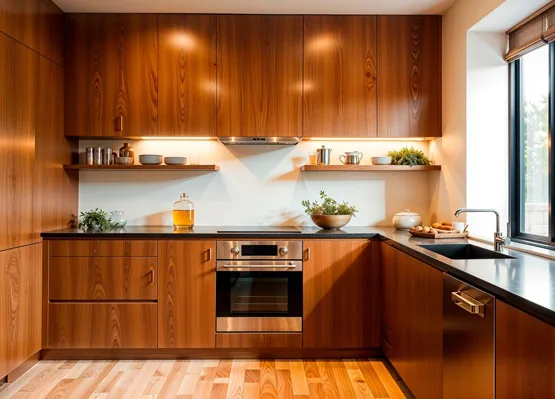
Best Modular Kitchen Materials for Chennai's Humidity
If you've ever pulled open a kitchen cabinet in a 10-year-old Chennai apartment and seen the carcass sides bubbling, the laminate peeling from the bottom edges, or the shelf bowing under its own weight — you've seen what the wrong materials look like after a few monsoons. Chennai is not kind to interior materials. Average humidity hovers around 75–85%, the sea breeze carries salt to apartments within 5 km of the coast, and the kitchen itself generates steam, oil mist, and heat every single day. Getting the material specification right is the difference between a 20-year kitchen and a 5-year disaster.
The Cabinet Carcass: Where You Cannot Compromise
The carcass — the structural box of your kitchen cabinet — is what you never see but what everything depends on. There are three materials used in Chennai kitchens:
- ISI-certified BWR plywood: The correct choice for most of the kitchen. BWR (Boiling Water Resistant) plywood uses phenol formaldehyde glue for its laminations. It won't delaminate in humid conditions. The ISI stamp guarantees minimum quality. This is what Budget Interiors uses as standard for all dry-zone cabinet carcasses.
- BWP / Marine-grade plywood: For any cabinet near the sink, adjacent to the dishwasher, or under the hob. Marine ply uses the same BWP adhesive as shipbuilding applications. It costs 20–30% more than BWR but in wet zones it's the only rational choice. We specify this automatically for sink base cabinets.
- Particle board and commercial ply: Used by budget vendors across Chennai. Particle board swells irreversibly when moisture penetrates the laminate edges. Commercial ply (without BWR or BWP grading) delaminates within 3–5 years in humid kitchens. Do not accept these materials for cabinet carcasses regardless of how it's described or how cheap the quote.
Shutter Materials Ranked for Chennai
1. Membrane-pressed MDF shutters — The best value-for-money choice for Chennai kitchens. Sealed edges prevent moisture ingress to the MDF core. Available in hundreds of matte and texture profiles. Holds up well in dry zones. Our most popular kitchen shutter choice in the ₹3–8 lakh range.
2. Acrylic shutters — High-gloss, scratch-resistant, and inherently moisture-resistant because the finish is the material itself. Premium choice that photographs beautifully. Excellent for Chennai's humidity but shows fingerprints and requires regular wiping. Adds ₹20,000–₹40,000 over laminate for a standard kitchen.
3. Laminate shutters — Good-quality laminates from Greenlam, Merino, or Century are moisture-resistant, particularly their kitchen-specific ranges. The risk is edge sealing — if edges are not properly sealed at the factory, moisture enters the substrate. Specify factory-sealed edges, not site-applied edge banding.
4. Glass shutters — For upper cabinets and display zones only, never base cabinets. Tempered glass with aluminium frame is fully moisture-immune and excellent for a display kitchen area.
Countertop Materials for Chennai Kitchens
Quartz: Non-porous, consistent pattern, doesn't need sealing, resists turmeric and tamarind. Best performing countertop material for Chennai's cooking style. ₹250–500/sq ft installed.
Granite: Natural stone, requires annual sealing to maintain stain resistance, shows absorption marks from oil and acidic ingredients without sealing. Good thermal resistance. ₹150–300/sq ft installed. Still a reasonable choice if maintained properly.
Solid surface / Corian: Seamless, repairable if scratched, non-porous. Good for kitchens where aesthetics are the priority. Less heat-resistant than stone — always use trivets. ₹350–600/sq ft installed.
Hardware Choices That Survive Chennai's Coast
Cheap zinc-alloy hinges and channel runners start rusting in Chennai kitchens — particularly in apartments in Adyar, ECR, Thiruvanmiyur, and Besant Nagar where salt air is significant. Specify stainless steel or nickel-plated hardware from Hettich or Häfele. The price difference over the full kitchen is ₹15,000–₹30,000. The service life difference is 10+ years.
Chennai's Specific Climate Challenges for Kitchen Materials
Chennai's climate creates a unique stress environment for kitchen materials that sets it apart from most other Indian cities. The northeast monsoon (October–December) brings sustained humidity of 85–95% RH — a level where unprotected wood swells, metal oxidises, and adhesives that perform fine in Mumbai or Bengaluru can begin to fail. Add daily steam from Tamil cooking patterns (pressure cooking, deep frying, boiling rice), salt air in coastal neighbourhoods, and summer temperatures exceeding 40°C, and the material specification for a Chennai kitchen needs to account for conditions that simply don't exist in landlocked, lower-humidity cities.
The practical implication: materials that are "good" by general standards can fail prematurely in Chennai. Commercial-grade plywood that performs adequately in a Delhi kitchen will swell and delaminate in a Chennai kitchen exposed to monsoon humidity and cooking steam within 5–7 years. Acrylic shutters that stay pristine in a Bengaluru apartment can show stress-cracking at edges in Chennai's coastal areas. Understanding these specific failure modes guides better material choices — not overkill specifications, but right-sized ones for this particular environment.
The Non-Negotiable: Plywood Specification for Chennai Kitchens
For kitchen cabinet carcasses (sides, bottom, back, internal shelves), ISI-certified BWR-grade plywood is the minimum appropriate specification in Chennai — not an upgrade, the baseline. BWR plywood uses phenol-formaldehyde resin between veneers, which resists moisture, steam, and the cyclical wet-dry cycles of Chennai's seasons. The relevant Indian standard is IS 303. Reputable brands: Century Ply CenturyBWR, Greenply Green Club, Kitply Club Prime, National Plywood BWR.
Thickness specification matters too: 18mm for all structural cabinet panels (sides, bottom, top), 12mm for internal shelves in standard-load applications. Drawers and drawer bottoms should use 12mm BWR plywood or 9mm for light-load drawers. Base cabinet bottom panels — which sit closest to the floor and face the highest risk from cleaning water and potential flooding — should be 18mm BWR with additional waterproof sealant on all exposed edges, particularly if your kitchen has an external wall or shares a wall with a wet area.
What to avoid: commercial-grade MR plywood (the most common cost-cut in Chennai kitchen projects), particleboard or chipboard for base cabinet carcasses (absorbs moisture rapidly and fails structurally), and "BWR equivalent" claims from vendors who can't show ISI certification. Specifying the brand and IS number in your contract removes ambiguity about what's actually being installed.
Countertop Materials Ranked for Chennai Conditions
Countertop selection has significant durability implications specific to Chennai's cooking patterns and climate. Engineered quartz tops the durability ranking for Chennai kitchens: non-porous (no sealing required), resistant to turmeric, tamarind, and cooking oil staining, heat-tolerant to direct cookware placement up to 150°C (above which a trivet is recommended), and unaffected by Chennai's humidity. Premium Indian quartz brands include Asian Granito, Pokarna, and Ceasarstone, with prices ranging from ₹350–900 per sq ft depending on thickness (20mm standard, 30mm premium). Foreign brands like Silestone and Cambria are available but command a significant price premium.
Granite is Chennai's traditional countertop choice and remains viable. Black Absolute granite and Rajasthan-quarried varieties handle heat, moisture, and impact very well. The disadvantages are the need for periodic sealing (every 1–2 years in humid climates) and the joint visibility in kitchens wider than the standard slab width. For traditional Indian kitchens where stone is familiar and natural patterns preferred, premium granite is an excellent long-term material. For contemporary kitchens where a seamless surface is desired, quartz is preferable.
Materials to avoid in Chennai kitchens: wooden or bamboo countertops (swell and crack in humid conditions, prone to black mould in joints), marble (too porous for tamarind and lemon juice in Indian cooking — stains permanently within months), and thin tile countertops (grout lines harbour bacteria and stain irreversibly with regular Indian cooking use).
Shutter Materials for Chennai's Specific Kitchen Conditions
The right shutter material depends on where in the kitchen it's used. The area most exposed to steam — directly above and beside the cooktop, and any shutter within 60cm of the sink — has different requirements from upper cabinets that rarely touch moisture. For these high-exposure lower zones, high-pressure laminate (HPL) from brands like Merino, Greenlam, or Stylam is the most resilient choice: the HPL surface is dense, non-porous, and maintains its bond even in sustained steam environments. Textured HPL in stone or wood finishes hides minor scratches well.
For upper cabinets and the visual focal points of the kitchen, acrylic or membrane shutters can work, but with Chennai-specific caveats. Acrylic shutters perform well away from direct steam and coastal salt air environments when quality brands like Rehau or Duratuf are used. In beachfront apartments in Adyar, Besant Nagar, or ECR, lower-grade acrylic can show stress-cracking or edge delamination within 4–5 years due to the humidity-salt combination — specify premium brands and ask about warranty terms. Membrane shutters with properly sealed edges perform reliably in Chennai kitchens when installed on moisture-resistant MDF cores — the edge sealing is critical and should be inspected at installation.
👉 Explore our Modular Kitchen options in Chennai
See Modular Kitchen designs & pricing →Ready to Transform Your Chennai Home?
Get a free 3D design consultation from Budget Interiors.
Get Free Design Consultation WhatsApp NowExplore Related Pages
Interested in this topic? View our modular kitchen designs Chennai — or learn more about our modular kitchen designers.

