Plywood Grades Explained: BWR, BWP and Marine Ply
📅 March 2026 · ⏱️ 6 min read · ✍️ Budget Interiors Design Team
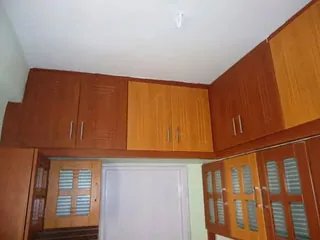
Plywood Grades Explained: BWR, BWP and Marine Ply
The most important decision in any interior project is one most clients never make directly — the grade of plywood used in the cabinet carcasses. It's invisible once installed. It's not something you choose from a colour chart. And yet it determines whether your kitchen holds up for 20 years or starts to fail in 5. In Chennai particularly, where humidity, salt air, and daily steam from cooking are constants, this choice is the difference between a lasting investment and an expensive renovation in a few years. Here's everything you need to understand about plywood grades before your project starts.
How Plywood is Made and Why Grade Matters
Plywood is made by bonding thin sheets of wood veneer together with adhesive. The type of adhesive — and the consistency of the manufacturing process — determines the grade. In a humid environment like Chennai, moisture works its way into the plywood through edges, joints, and any unsealed surface. If the adhesive between laminations isn't waterproof, moisture causes delamination: the plies separate, the sheet swells, and the structural integrity is lost. The ISI grading system classifies plywood by its adhesive moisture resistance.
MR Grade (Moisture Resistant)
The lowest grade. Uses urea formaldehyde adhesive which has limited water resistance — it resists moisture in dry conditions but fails under sustained humidity or any direct water contact. Sometimes sold as "commercial ply" or "standard ply." Never appropriate for Chennai kitchens, bathroom storage, or any application with moisture exposure. Fine for interior non-structural use in completely dry conditions — picture frame backings, display board backing. Not for cabinet carcasses anywhere in a Chennai home.
BWR Grade (Boiling Water Resistant)
The correct standard for residential interior carpentry in Chennai. BWR plywood uses phenol formaldehyde adhesive — the same chemistry used for exterior applications. It can withstand continuous exposure to high humidity, steam, and intermittent moisture contact without delaminating. The ISI standard for BWR plywood is IS:303. Every sheet should have the ISI mark, the grade designation (BWR), and the manufacturer's details printed on it.
This is what Budget Interiors uses as standard for all bedroom wardrobes, living room TV units, study tables, and the dry zones of kitchen cabinets.
BWP Grade (Boiling Water Proof / Marine Ply)
The highest grade. BWP uses a phenol formaldehyde adhesive with even higher water resistance — tested by boiling a test piece for 72 hours with no delamination. The ISI standard is IS:710 for marine-grade plywood. It costs approximately 25–35% more than BWR but is the only rational choice for:
- Kitchen sink base cabinet (sits in a puddle every time the sink overflows)
- Any cabinet within 300mm of the hob (steam and condensation)
- Bathroom vanity units and storage cabinets
- Apartments below the third floor in areas prone to ground flooding
- Coastal Chennai apartments (Adyar, Besant Nagar, ECR) where salt-laden humidity is extreme
How to Verify What You're Getting
Ask to see the plywood sheets before cutting. Check for: the ISI mark (a registered certification, not just a printed logo), the grade designation in text, and the manufacturer name. Run your hand across the edge of a cross-section — BWR and BWP ply has consistent, tight laminations with no visible voids or gaps between layers. If you see voids, reject the sheet regardless of what grade is claimed.
A reliable indicator: ask your vendor to show you the ISI certification mark on the plywood sheets being used. Budget Interiors uses only ISI-certified BWR/BWP plywood and can provide the certification details for every project.
Thickness Guide for Common Applications
- Kitchen cabinet carcasses (sides, top, base): 18mm BWR
- Kitchen sink base: 18mm BWP / marine
- Cabinet shelves and internal divisions: 12mm BWR
- Wardrobe carcasses: 18mm BWR
- Wardrobe internal shelves: 12mm BWR
- TV unit structure: 18mm BWR
- Loft storage structure: 12mm or 18mm BWR
Why Plywood Grade Matters More in Chennai Than Anywhere Else
Chennai's climate creates some of India's most demanding conditions for interior woodwork: monsoon humidity that can reach 85–90% RH during the northeast monsoon (October–December), kitchen steam from intensive Indian cooking, occasional flooding in ground-floor apartments, and coastal salt air in areas like Adyar, Besant Nagar, ECR, and Thiruvanmiyur. These conditions make plywood grade selection the single most important structural decision in your interior project — more impactful than brand, finish, or hardware choice.
Most interior failures in Chennai homes — warped cabinet doors, swollen drawer bottoms, delaminating panels — trace back to one cause: the wrong plywood grade was used. Commercial MR grade plywood, which makes up the majority of low-cost interior work in Chennai, is moisture-resistant only in name. It handles normal indoor humidity, but in kitchen and bathroom environments with direct moisture exposure, it typically starts failing within 3–5 years. The cost saving on plywood grade is real at project time — approximately ₹20,000–35,000 for a full 2BHK — but carries a disproportionate cost in replacement and repair within a decade.
MR Grade vs BWR Grade vs BWP Grade: The Technical Difference
MR (Moisture Resistant) grade plywood uses urea-formaldehyde adhesive between veneers, which performs adequately in dry interior conditions but breaks down with sustained moisture exposure. The "moisture resistant" label is technically accurate for normal humidity but misleading for Chennai's wet-season conditions. This is the plywood used in most budget interior projects across Chennai.
BWR (Boiling Water Resistant) grade uses phenol-formaldehyde adhesive, which is significantly more resistant to moisture, steam, and heat. BWR plywood is tested by submerging in boiling water for 8 hours — panels that pass this test maintain their bond integrity in Chennai's monsoon conditions, kitchen steam environments, and coastal humidity. ISI-marked BWR plywood (IS 303 standard) carries Bureau of Indian Standards certification and is manufactured by brands like Century Ply, Greenply, Kitply, Archidply, and Duroply. This is the minimum appropriate grade for all kitchen cabinets, bathroom vanities, and any below-counter furniture in Chennai homes.
BWP (Boiling Waterproof) grade — sometimes called Marine Plywood — uses the same phenol-formaldehyde adhesive system but with higher-quality veneer selection and tighter manufacturing tolerances. BWP/Marine plywood is tested to even more stringent immersion standards and is appropriate for direct water contact situations: boat building (its original purpose), bathroom vanities where water regularly splashes the cabinet faces, under-sink cabinets, and external-use applications. For standard kitchen and bedroom furniture in Chennai, BWR grade is the correct specification — BWP is an overkill upgrade that adds 30–40% cost without proportional benefit in non-submersion environments.
Reading ISI Certification: What to Look For
ISI marking on plywood means the batch has been tested and certified by the Bureau of Indian Standards against the relevant IS specification. For BWR plywood, the relevant standard is IS 303. Each plywood panel from a certified manufacturer carries the ISI mark (the interconnected triangles symbol) along with the IS number, the manufacturer's licence number, and the date of manufacture. This information is stamped directly on the panel surface or on the edge banding.
When your interior vendor claims to be using "ISI-certified plywood," ask to see the panels before they're cut and ask for the manufacturer's name. Reputable brands: Century Ply (CenturyPly BWR), Greenply (Green Club BWR), Kitply (Club Prime), Archidply, Duroply, and National Plywood. Less reputable practice: some vendors purchase lower-grade plywood and apply ISI stickers — this is fraudulent but not uncommon in the unorganised segment of the Chennai market. Specifying the brand by name in your contract removes this ambiguity.
Budget Interiors uses Century Ply or Greenply BWR-grade ISI-certified plywood across all project work. We maintain purchase receipts and can show these to clients on request. The specific plywood specification is written into every project contract so there's no scope for substitution once the job is confirmed.
MDF vs Plywood: When Each is Appropriate
Medium Density Fibreboard (MDF) is often used for shutter panels, profiles, and decorative elements — and is appropriate for these applications when moisture-resistant (MR MDF or HMR MDF) grades are used. MDF has advantages over plywood for shutters: it has no grain, so routed profiles are smooth and consistent, and painted or wrapped surfaces adhere better. Its disadvantage is weight (heavier than plywood), edge-holding ability (screws at edges of MDF can strip over time), and moisture sensitivity — standard MDF is more susceptible to humidity than BWR plywood and should not be used for cabinet carcasses in Chennai kitchens.
The correct specification for Chennai kitchen cabinetry is: BWR ISI plywood for all cabinet carcasses (sides, bottom, top, shelves), and moisture-resistant MDF or BWR plywood for shutter panels depending on the finish. This combination gives you structural integrity from the carcass plywood and the smoothest possible finish substrate from the MDF shutters. This is Budget Interiors' standard specification for all kitchen projects.
👉 Explore our Modular Kitchen options in Chennai
See Modular Kitchen designs & pricing →Ready to Transform Your Chennai Home?
Get a free 3D design consultation from Budget Interiors.
Get Free Design Consultation WhatsApp NowExplore Related Pages
Interested in this topic? View our ISI plywood modular kitchen and plywood wardrobes Chennai — or learn more about our wood interior design.

