Sliding Wardrobe vs Hinged Wardrobe — Which Should You Choose?
📅 March 2026 · ⏱️ 5 min read · ✍️ Budget Interiors Design Team
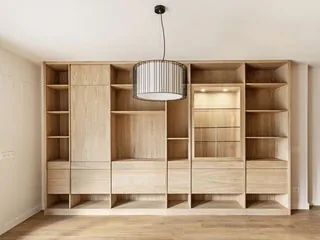
Sliding Wardrobe vs Hinged Wardrobe — Which Should You Choose?
It's one of the first decisions in any bedroom interior and one of the most debated. Clients walk in with a strong opinion either way — usually based on what they've seen at a friend's house or what's currently trending on Instagram. The reality is that neither type is universally better. The right choice depends on your bedroom size, how you store clothes, your cleaning habits, and your budget. Here's the honest breakdown.
Sliding Wardrobes — When They Make Sense
Sliding wardrobes (sliding shutters on aluminium rails) are the right choice when floor space in front of the wardrobe is limited. If your bedroom can't accommodate 18–24 inches of clearance for a hinged door to swing open, sliding is your only viable option. This covers a significant number of Chennai apartments — particularly in T. Nagar, Mylapore, and older Adyar buildings where bedrooms are compact.
Advantages of sliding: No clearance needed for door swing. Clean, contemporary look. Large format mirror doors (a popular choice) make the bedroom feel more spacious. Works seamlessly in tight spaces.
Disadvantages: You can only access half the wardrobe at a time — one door always blocks part of the interior. Tracks accumulate dust and need regular cleaning. The sliding mechanism (wheels on track) degrades faster than hinges and needs replacement or adjustment every 5–8 years. Not suitable for very deep wardrobes where rear storage becomes inaccessible.
Hinged Wardrobes — When They Make Sense
Hinged wardrobes (traditional door on hinges) give full, unobstructed access to the entire interior when open. They're more practical for organised storage — you can see everything at once, and deep interior fittings like pull-out trouser racks and accessory trays are easily accessible.
Advantages of hinged: Full interior access. More storage organisation options. Simpler mechanism — quality hinges last longer and are easier to adjust than sliding tracks. Suitable for deeper wardrobes (above 600mm).
Disadvantages: Requires clearance space for the door swing. Multiple hinged doors in a row can look dated compared to a continuous sliding panel. Doors can warp over time in humid conditions if material quality is poor (another reason to insist on BWR plywood and properly sealed edges).
The Size Question — Chennai Bedroom Realities
In a standard Chennai 2BHK master bedroom (typically 130–160 sq ft), a wardrobe along the 10–12 ft wall with a bed centred on the opposite wall usually leaves 8–10 ft of clear space between the wardrobe and the bed foot. That's enough for hinged doors with comfortable clearance. In a children's room or second bedroom (typically 80–110 sq ft), the clearance is often tighter, and sliding becomes the more practical choice.
Cost Comparison
Sliding wardrobes typically cost 10–20% more than hinged wardrobes of the same size and material specification. The sliding track system (particularly for quality aluminium profiles from Hafele or Hettich) adds ₹8,000–₹20,000 per wardrobe over the equivalent hinged doors. If budget is a deciding factor, hinged is the more economical choice without sacrificing quality.
Our Recommendation
If your bedroom has adequate space: hinged for master bedroom (better access, better for deep organised storage), sliding for children's room or guest room where space is tighter and a mirror door is useful. If space is genuinely constrained: sliding, with a quality track system — not the cheapest one available.
Practical Guide for Chennai Homes
When considering sliding wardrobe vs hinged wardrobe — which should you choose? for a Chennai home, the climate and local living patterns play a significant role in the right approach. Chennai's combination of monsoon humidity (peaking at 85–95% RH during the northeast monsoon), year-round heat above 28°C, and — in coastal areas — salt air creates specific requirements that generic interior design advice often overlooks. Every decision in this category should be evaluated against Chennai's specific conditions, not just aesthetic preference or price alone.
The most successful Chennai interiors in this category share a common thread: materials selected for local climate performance, specifications adapted for intensive Indian household use, and maintenance requirements that are realistic for a working Chennai family. This means prioritising durability and ease of maintenance alongside aesthetics — choices that look identical in a showroom but diverge significantly in performance after three monsoon seasons.
Budget Interiors has completed projects across Chennai — from Perumbakkam and OMR to Kilpauk, Anna Nagar, and Adyar — giving us a clear picture of which approaches hold up and which fail under local conditions. The guidance in this article draws from that project experience, not from generic design principles.
Materials and Specifications That Matter
For any fixed interior work in this category, the specification of structural materials — particularly plywood — has a disproportionate impact on long-term performance. ISI-certified BWR (Boiling Water Resistant) plywood, manufactured to IS 303 standard by brands like Century Ply, Greenply, or Kitply, is the minimum appropriate specification for Chennai's humidity conditions. This is the plywood that won't warp, swell, or delaminate through the northeast monsoon cycle year after year. Budget Interiors uses ISI-certified BWR plywood on all structural carcass work as standard — not as a premium upgrade, as the baseline.
Surface finish choices should consider where in the home the work is located and what exposure it will face. Kitchen and bathroom-adjacent areas require different specification from bedroom furniture. Hardware selection — hinges, drawer runners, handles — similarly needs to account for load, use frequency, and moisture proximity. Soft-close Hettich hardware on kitchen drawers handling heavy Indian vessels is an investment that pays back in daily usability and decade-long performance; local-brand alternatives save ₹15,000–25,000 upfront but typically require replacement within 5–7 years of intensive use.
Planning and Budgeting Realistically for Chennai
Realistic budget planning for this type of interior work in Chennai involves understanding the total cost of ownership, not just the installation cost. Materials with higher upfront cost — ISI plywood over commercial grade, Hettich hardware over local alternatives, quartz countertops over granite — typically have lower total cost over 10 years when you factor in the avoided replacement and repair costs. The calculation is specific to Chennai because our climate accelerates material degradation in ways that make the quality premium more valuable here than in milder climates.
Getting an accurate quote requires providing accurate inputs: your flat's actual dimensions, your scope of work in detail, and your material preferences. Quotes based on approximate dimensions or vague scope are not comparable — a quote for "kitchen with wardrobes" can represent anything from ₹4 lakhs to ₹15 lakhs depending on specification and scope. Budget Interiors provides itemised quotes with every material and component specified by name and grade, so you can compare our numbers directly with any other vendor's on equal terms. The free site visit and 3D consultation is where this specificity begins.
Questions to Ask Your Interior Designer
Before committing to any interior project in this area, these questions help distinguish professional vendors from those who will disappoint: "What plywood grade and brand do you use, and can you show me the ISI certification?" — the answer should be specific and verifiable. "What hardware brand do you specify for the moving parts?" — again, specific brand and model, not "good quality hardware." "What warranty do you provide, and what does it cover specifically?" — duration, what failures are covered, and the rectification process should all be explicit. "Can I visit a completed project similar to what I'm planning?" — most satisfied clients will accommodate this when asked, and a site visit reveals quality that photography cannot.
Budget Interiors offers 10-year warranty on all project work, 15-day delivery commitment once materials are confirmed, and free 3D design consultation before any payment commitment. These commitments are written into every project contract, not verbal assurances. Contact us for a site visit and quote — we're available Monday to Saturday, 9am to 7pm.
👉 Explore our Wardrobes options in Chennai
See Wardrobes designs & pricing →Ready to Transform Your Chennai Home?
Get a free 3D design consultation from Budget Interiors.
Get Free Design Consultation WhatsApp NowExplore Related Pages
Interested in this topic? View our custom wardrobes Chennai — or learn more about our bedroom interior designers Chennai.

