L-Shaped Modular Kitchen Designs for Chennai Apartments 2026
📅 March 2026 · ⏱️ 6 min read · ✍️ Budget Interiors Design Team
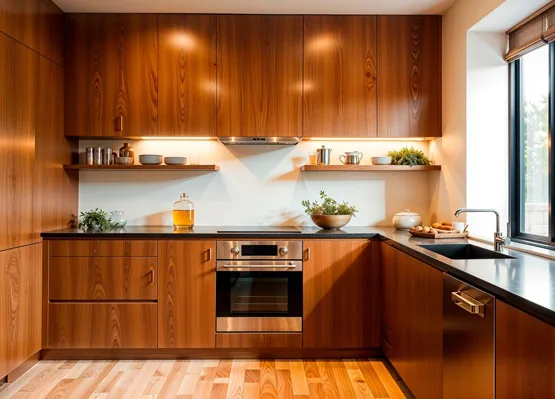
L-Shaped Modular Kitchen Designs for Chennai Apartments in 2026
If you ask a Chennai interior designer what layout they'd recommend for a standard 2BHK apartment kitchen, the answer is almost always L-shaped — and there are good reasons for that. The L-shape uses a corner efficiently, creates a natural work triangle between the hob, sink, and refrigerator, and adapts to the wide range of kitchen sizes found across Chennai apartments, from the compact 60 sq ft kitchens in older Mylapore flats to the more generous 100+ sq ft kitchens in new OMR and ECR developments. Here's everything you need to know to design yours well.
What Makes an L-Shaped Kitchen Work
The geometry of an L forces you to think about two things: the corner and the work triangle. The corner is often wasted in poorly designed L-shaped kitchens — a standard cabinet on each side means a dead zone in the corner that's unreachable. Modern corner solutions fix this completely:
- Magic corner / carousel unit: A pull-out mechanism that brings the corner shelf out to you. Full access to everything stored there. Adds ₹8,000–₹15,000 to the cabinet cost but eliminates the dead zone entirely.
- Blind corner with maximiser: A simpler pull-out that captures roughly 70% of the corner space. Less expensive but still a significant improvement over fixed shelves.
- Open corner shelf: If budget is tight, an open shelf at the corner of the upper cabinets at least makes the space accessible and can be a display zone.
The Work Triangle in an L-Shaped Chennai Kitchen
The ideal work triangle (hob to sink to refrigerator) in an L-shaped kitchen has each leg between 4 and 9 feet, with the total triangle perimeter under 26 feet. In a typical Chennai 2BHK kitchen, this usually means: sink on one arm of the L, hob on the other arm, refrigerator near the junction or at one end. Getting this right during design is far easier than trying to rearrange plumbing points after installation.
Height Considerations for Chennai Apartments
Most Chennai apartments have 9 ft or 10 ft ceiling heights. With 10 ft ceilings, you can specify base cabinets (34 inches height standard), a countertop, a backsplash zone, and full-height wall cabinets right to the ceiling — maximising storage and creating a seamless, built-in look. With 9 ft ceilings, a small gap above wall cabinets is often unavoidable unless you add a cornice board, which traps dust. We design around your specific ceiling height.
Popular L-Shaped Kitchen Designs We're Building in 2026
The minimalist two-tone: Matte white upper cabinets, warm walnut-grain lower cabinets, quartz countertop in light grey. Clean, warm, practical. Works in any size Chennai apartment.
The bold lower half: White or cream upper cabinets, deep navy or forest green lower cabinets, brass handles, white quartz countertop. Makes a strong statement while keeping the space feeling open.
The all-laminate budget build: Consistent matte grey or beige laminate throughout, granite countertop, Hettich hardware. Genuinely good-looking and practical at a significantly lower price point than the premium builds above.
Pricing for L-Shaped Kitchens in Chennai 2026
- Small L-shape (8 ft × 6 ft, basic laminate): ₹2.5–3.5 lakhs
- Standard L-shape (10 ft × 8 ft, mid-range): ₹4–6 lakhs
- Large L-shape (12 ft × 10 ft, premium finishes): ₹7–12 lakhs
- L-shape with breakfast counter extension: add ₹60,000–₹1.2 lakhs
Why L-Shaped is Chennai's Most Common Apartment Kitchen Layout
The L-shaped kitchen — cabinets running along two adjacent walls meeting at a corner — is the dominant layout in Chennai's apartment stock for a straightforward reason: it's the natural fit for the kitchen dimensions that most Chennai 2BHK and 3BHK apartments provide. Standard Chennai apartment kitchens range from 8×8 feet to 10×12 feet, with at least one external wall (for the window mandated by Chennai building bylaws) and typically one wall shared with the utility or bathroom. The L-shape uses two of these walls efficiently, creates a natural work triangle (cooktop on one leg, sink and preparation on the other), and allows the window to serve either natural ventilation in the kitchen or light on the preparation counter depending on its position.
The efficiency of the L-shape depends critically on corner treatment. The inside corner of an L-shaped kitchen — where the two cabinet runs meet — is the most space-inefficient area in any kitchen, with approximately 60–70% of the theoretical storage volume in the corner cabinet inaccessible without proper corner solutions. A standard "blind corner" cabinet where one run extends into the corner and the other terminates beside it leaves usable space that's difficult to reach. The solutions — corner carousel (Le Mans unit), pull-out corner systems, or magic corner pull-outs — each have different performance characteristics that matter differently in Indian cooking contexts.
Corner Solutions for Indian Kitchens: What Works in Practice
The Le Mans carousel (named for the racing track shape of its twin shelves) is the most popular corner solution in Chennai's mid-range kitchen market. It consists of two kidney-shaped shelves mounted on a pivot mechanism that swings out and forward when the cabinet door is opened, making the full depth of the corner accessible. For Indian kitchens storing medium-weight items (smaller pressure cookers, bowls, storage containers), the Le Mans works well and adds approximately ₹8,000–14,000 to the corner cabinet cost versus a plain shelf.
For heavy items — large pressure cookers, grinding stones, heavy vessels — the Le Mans carousel is not ideal because the pivot mechanism is stressed by heavy loads and the mounting points can loosen over time. For these applications, a "magic corner" pull-out (also called a swing-out corner unit) or a simple deep drawer configuration at the corner is more structurally appropriate. Magic corner units use two linked shelf stages that cascade out toward the user when the door is opened, making the full corner depth accessible without a weight-bearing pivot. They cost more than a Le Mans unit (₹15,000–22,000 for the hardware) but handle Indian kitchen loads more reliably.
The simplest and most durable corner solution for heavy-load Indian kitchens is a deep drawer module positioned at the corner: a 600mm wide, three-drawer unit at the corner, with the drawers running perpendicular to the main run, provides unobstructed access to the entire cabinet volume without pivot mechanisms. It uses the corner space somewhat less efficiently than carousel solutions but is mechanically simple and handles any load without degradation. Budget Interiors proposes this solution for clients who regularly use very heavy kitchen equipment and want the most durable storage system.
Optimising the L-Shape for Tamil Cooking Patterns
Tamil Nadu cooking patterns — multiple pressure cooker preparations running simultaneously, significant grinding and wet processing, heavy use of the sink for washing rice and vegetables, and deep-frying — create specific workflow demands that should inform the L-shape configuration. The highest-priority placement decision: the cooktop position. In Chennai kitchens, the cooktop is used intensively and for long durations during major cooking sessions. It should be placed where: there is clearance on both sides (minimum 15cm, ideally 30cm) for pots to rest after removal, ventilation is proximate (either a chimney directly above or a window within 60cm), and the cook faces into the kitchen (not toward a wall) during intensive cooking if the floor plan allows.
The sink and preparation area on the second leg of the L should have counter space on both sides: landing space to the right (or left, depending on handedness) for washed produce coming out of the sink, and preparation space where the counter is widest and most usable. In a 10×10 foot L-shaped Chennai kitchen, this typically means: one leg of 8 feet (hob area with base cabinets below and wall cabinets above), one leg of 8 feet (sink + prep with deep base drawers for vessel storage below and wall cabinets above), and the corner handled by a pull-out or carousel unit. With an appropriate chimney above the hob and LED strip lighting under the wall cabinets above the prep area, this is a highly functional configuration for Indian cooking.
👉 Explore our Modular Kitchen options in Chennai
See Modular Kitchen designs & pricing →Ready to Transform Your Chennai Home?
Get a free 3D design consultation from Budget Interiors.
Get Free Design Consultation WhatsApp NowExplore Related Pages
Interested in this topic? View our L-shaped modular kitchen Chennai — or learn more about our modular kitchen designers.

